Yank the Hose Sideways Without Setting a Kink
Four spring-loaded rollers steer the line back onto the drum, so a sideways pull re-spools flat instead of folding at the mouth.
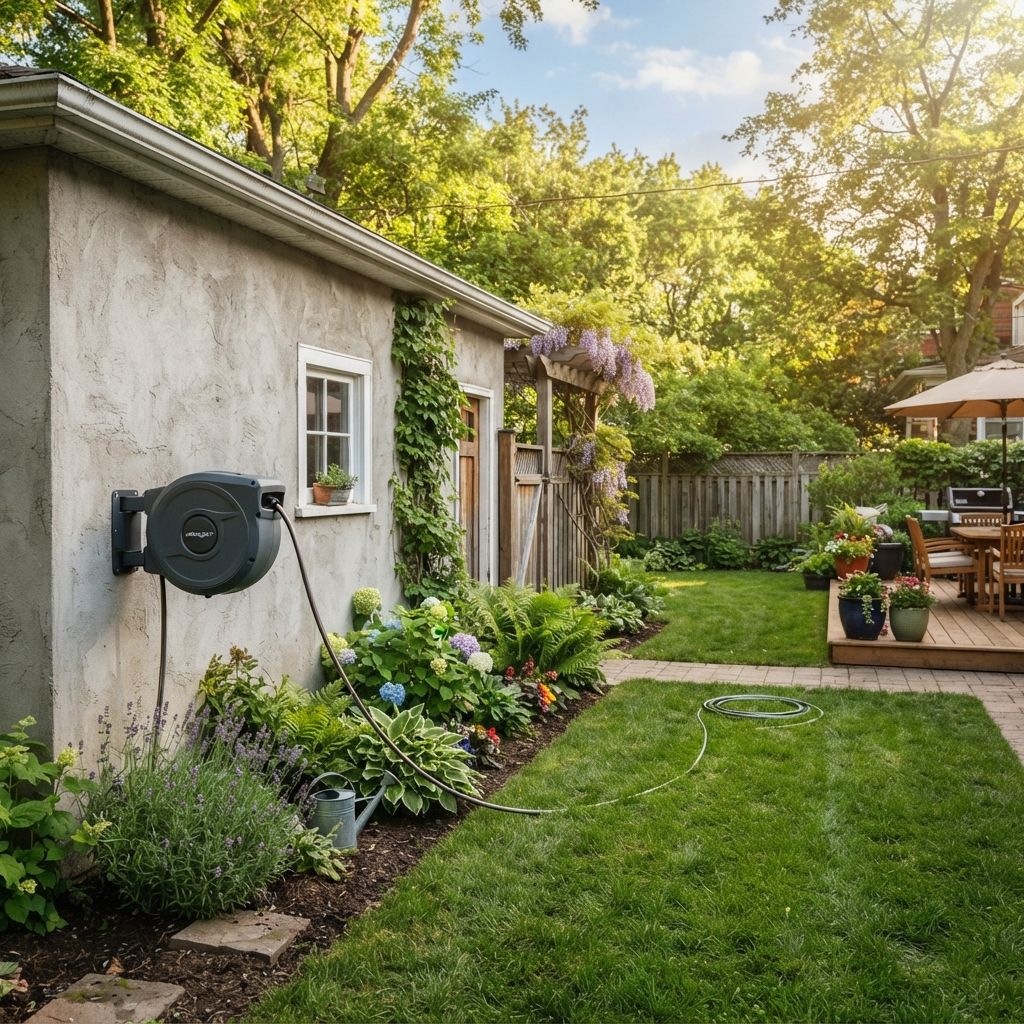
Auto-rewind hose reels
Tired of a hose that kinks the second you drag it? These reels rewind themselves, and they hold a 4.2-star average across 763 verified buyer reviews.
Ruvup reels carry a printed pressure rating, a 180-degree swivel, and a 34 lb housing you bolt up in one afternoon.
Four spring-loaded rollers steer the line back onto the drum, so a sideways pull re-spools flat instead of folding at the mouth.
Blast a paver patio at full mains pressure for an hour; the Ruvup garden hose holds its rating without weeping at the crimp.
The ratchet catches wherever you stop pulling, so 40 ft stays out while the rest of the line stays wound.
Swing the housing toward the driveway, then back to the beds, and the hose feeds straight out either way.
Leave the drum on an unheated wall through January, hook a hose to it in April, and the anti-UV polymer opens without a cracked seam after two seasons outside.
Check the housing and bracket the day the crate lands. Find a cracked shell in the crate and the retailer's 30-day return window swaps it before the first watering.
Wall-mounted reels for the yard and the garage: 100 ft and 150 ft garden lines, plus 75 ft of air line for the compressor.
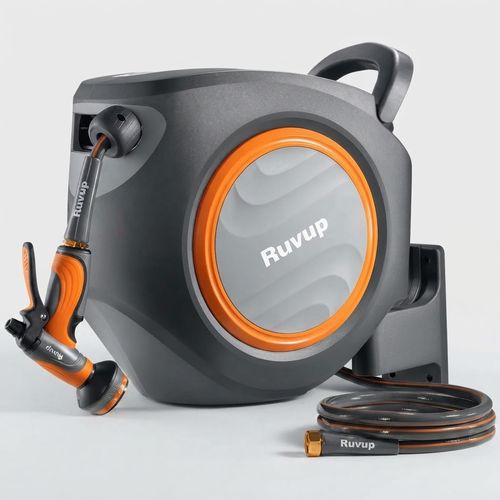
Walk 100 ft of hose to the back fence, drop it, and the drum takes the whole length back without a tangle in the grass. Feed the 348 PSI three-layer hose through the spring-loaded guide once and each wrap layers flat, because an even stack keeps the last 10 ft from binding at the mouth. Where a bargain reel folds its hose at the first sideways tug, the 5/8-inch line here holds its shape and full flow to the nozzle all season. Pull the wall bracket, expansion screws, instruction book, and multi-pattern spray gun out of the crate the day it lands, and check the housing seam while the retailer's 30-day return window is still wide open.
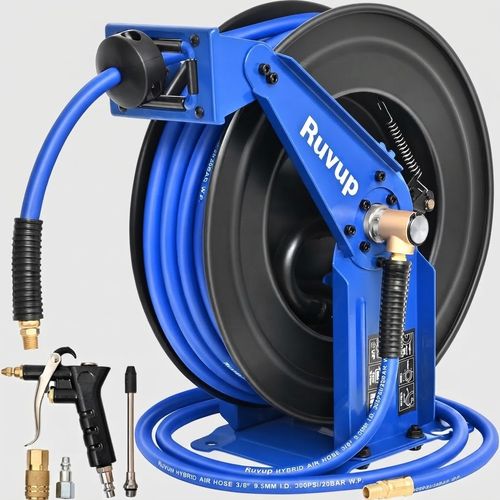
Run an impact wrench 75 ft from the compressor and the lead line stays off the concrete instead of coiling around a jack stand. Click the ratchet out to the tire bay, then back in for a paint gun in the next stall, and neither job costs you a full rewind in the same afternoon. Where budget air reels give one stop near full extension and a plastic shell, this one runs a steel frame and 1/4 NPT brass fittings. Size the compressor regulator to the 150 PSI reel-body limit rather than the 300 PSI hose material rating, and check the crate inside the 30-day return window.
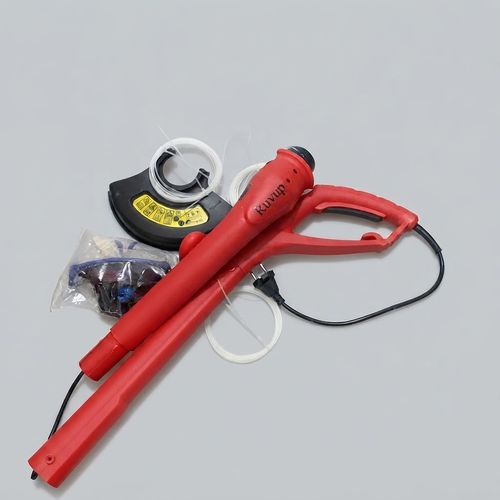
Push a 1.35 kg mower around a flowerbed with one hand, and your wrists stay out of a job that usually wrecks them by the second pass. A 400W brush motor spins the blade to 12,400 RPM, which is what lets a deck this light still cut damp grass cleanly. Where a gas walk-behind needs fuel, a pull cord, and a winter carburetor cleaning, this one runs off 200 to 240V mains. A 220mm cutting width suits small lots and border strips rather than open acreage, so check today's price and the return window before ordering.
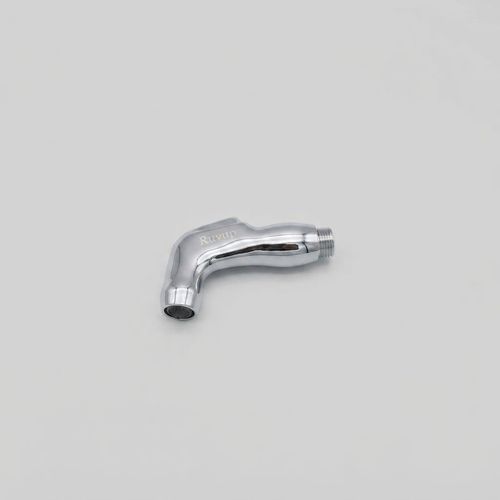
Squeeze the lever to knock aphids off a rose cane, release it, and the flow stops without a walk back to the spigot. Work a full rose bed one-handed for ten minutes: the chrome-plated ABS body holds the head at 65 g, so your wrist quits long after the bed does. Where plastic nozzles crack after a summer of sun and one night of frozen water inside, the chrome shell shrugs off both. The universal press-fit interface matches most standard sprinkler hoses, so confirm your thread type and check the return window before ordering.
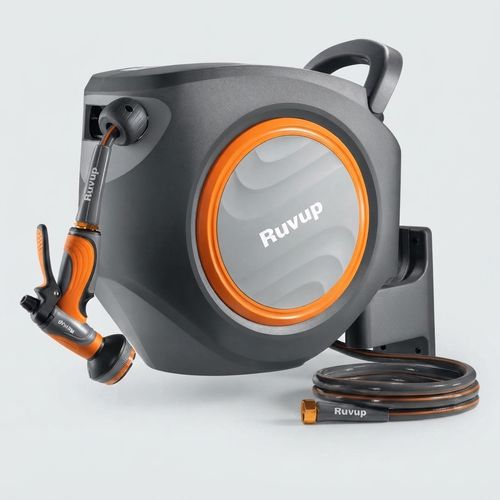
Reach the far corner of a half-acre lot at 150 ft, then let the reel wind every foot back while you coil nothing by hand. Lift the 34.4 lb housing onto the bracket alone, because the narrower 1/2 bore keeps 150 ft of hose from adding weight your studs carry all season. Where a shorter reel forces a leader hose out to a detached bed, this length usually gets there on its own from the first hookup. Lift the stop-anywhere ratchet, the 180-degree swivel bracket, and the multi-pattern nozzle out of the box the day it lands, and the retailer's 30-day return window covers a cracked shell the same way it does the shorter reel.
Check these against the reel page you have open: spec-sheet figures and 763 verified reviews, including the PSI number most sellers never split.
| Metric | What it changes for you | Source |
|---|---|---|
| 348 PSI | Full mains pressure strips winter grit off a paver patio in a single Saturday session. Hold the trigger down that whole time and the three abrasion-resistant layers carry the 348 PSI without the line becoming the weak point.Spend ten minutes scrolling competing reel pages before you buy, and you collect the words heavy duty over and over and a printed PSI figure not once. | manufacturer spec |
| 4 rollers | Count the rollers at the housing mouth before you drill the first hole into siding. Drag the line sideways toward the far bed and the four spring-loaded rollers keep it stacking flat across the drum through a full watering season.Count the rollers in the product photo before you trust an anti-kink claim: half the pages you scroll print the phrase, almost none print the number. | manufacturer spec |
| -40F to 150F | Owners who left the air reel bolted to an unheated garage wall through a hard freeze had it running at the first spring hookup. Check the housing again after the thaw: the hybrid line is rated from -40F to 150F and comes out of winter without a seized coil.Run a finger down the spec table for a temperature next to frost resistant before you plan winter storage: the phrase sits there, the number almost never does. | manufacturer spec |
| 4.2 stars / 763 reviews | Read the buyers who ran these Ruvup reels through a full watering season before you drill anything. Scroll the 763 verified reviews behind that 4.2-star average, angry ones included, before you commit a Saturday to drilling.Hunt a no-name reel page for a verified review count that size and you close the tab inside a minute. | 763 verified buyer reviews |
| 34 lbs | At 34 lbs the housing rides up a stepladder on one shoulder and rests on the top shelf while you line up the bracket. Hold it flat against the studs and drive the first screw without a second set of hands waiting below.Check the shipping weight before you book a helper for Saturday, because the number that settles a one-person mount rarely reaches the spec table. | manufacturer spec |
| 150 PSI at the body | Size a compressor regulator to the 150 PSI reel-body limit, not the 300 PSI stamped on the hose material. Do that on the bench before you hook a shop compressor to the coupler for the first time.Read the pressure figure twice before you hook a compressor to the coupler: the hose jacket carries one number, the reel body another, and product pages rarely separate them. | product manual |
Four situations decide whether a reel lasts one season or five: a sideways pull, a locked length, 75 ft of air line.
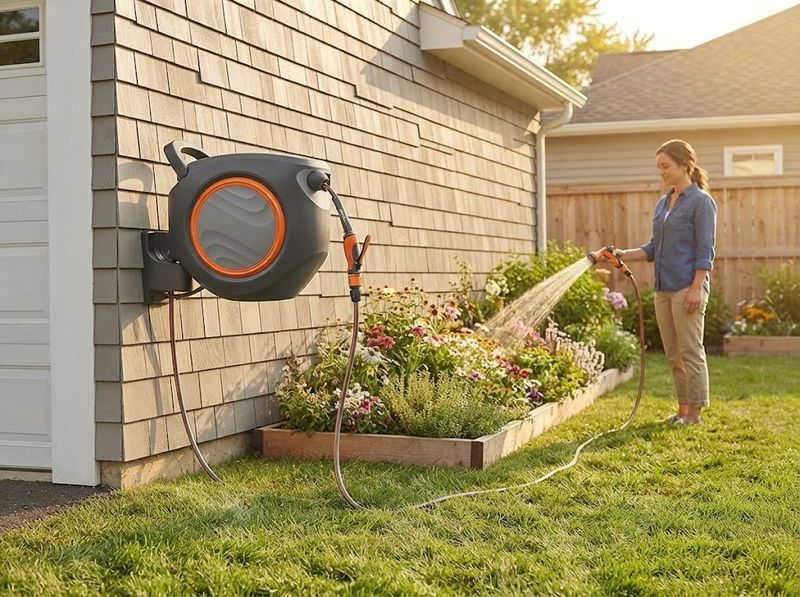
Drag the hose sideways around the garage corner and the 4-roller guide at the housing mouth still steers it back onto the drum flat. Let go from that angle and the line re-spools without folding into a kink at the mouth. Most reel pages mention an anti-kink guide without saying how many rollers do the work behind the shell.
That count decides whether your line stacks evenly across the drum or piles onto one side by August. Rinse mud off the hose before it winds back and the tracking stays clean through the whole watering season.
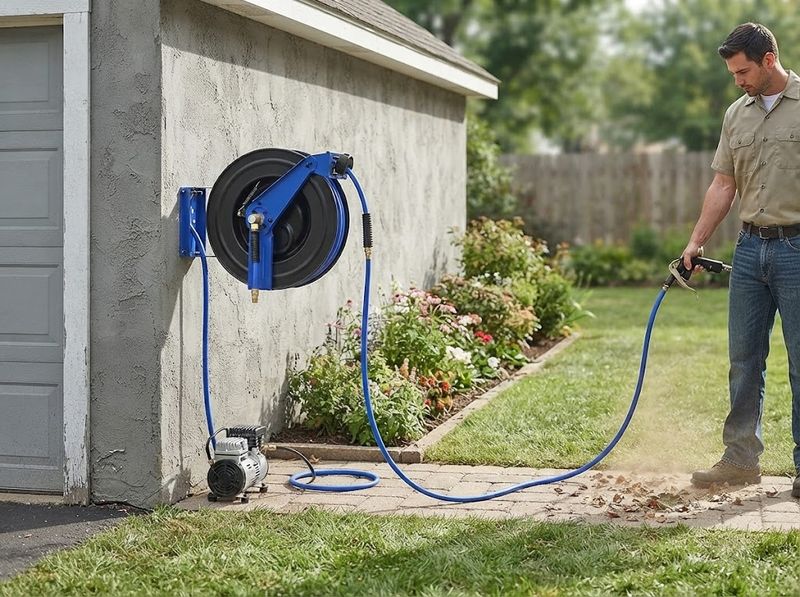
The garden reels lock at any pulled length; the air reel steps through a 12-position ratchet. Stop at 40 ft to fill a watering can and the drum holds there instead of creeping back toward the wall. Budget air reels usually give one stop point near full extension, which forces you to work at that length or none.
A click every few feet lets you set a short length for a tire job, then reset it for a paint gun. The catch releases on a single tug, so nothing has to be unwound by hand first.
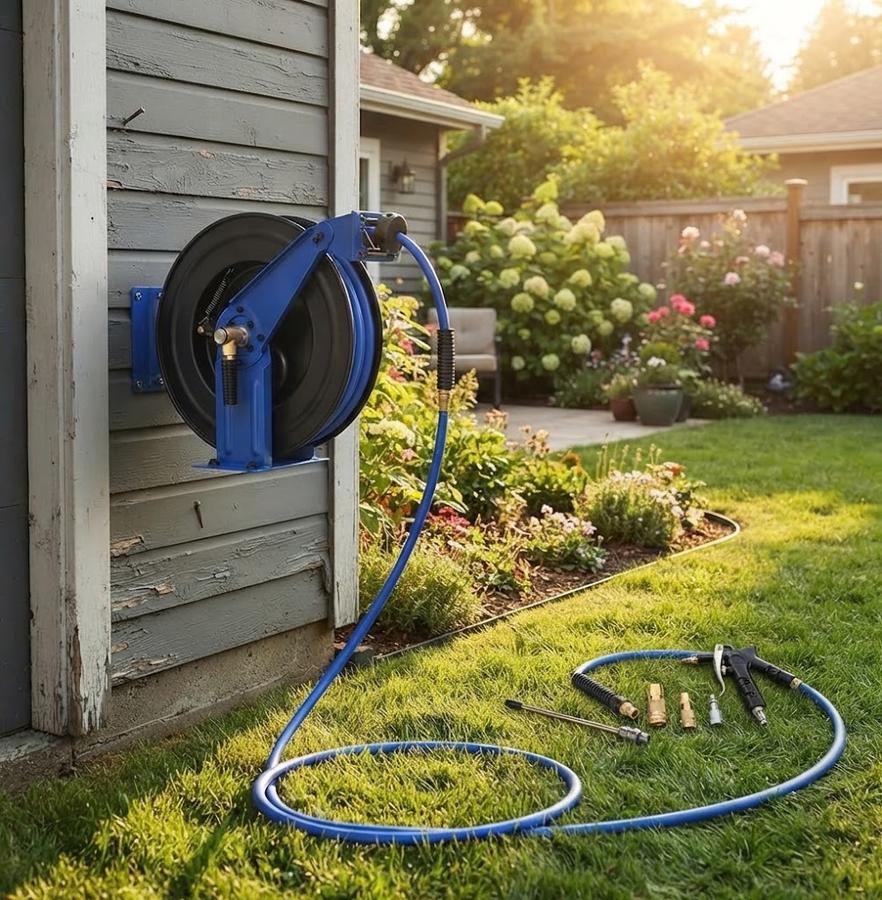
Thread the Ruvup Air Hose Reel onto a 1/4 NPT coupler, pull 75 ft of hybrid line across the shop floor, and an impact wrench runs at the far bay all afternoon. Roll a jack to the far bay, break lug nuts on a truck, and the line stays off the concrete. Hook the 6.5 ft lead hose straight onto the compressor port the day you mount the reel, and the adapter run to the hardware store never happens.
Set the compressor regulator to the reel body limit of 150 PSI, not the 300 PSI printed on the hose material. Let a stiff hybrid line slam home at the end of a pull; the steel frame eats the recoil that splits a plastic housing inside one season.
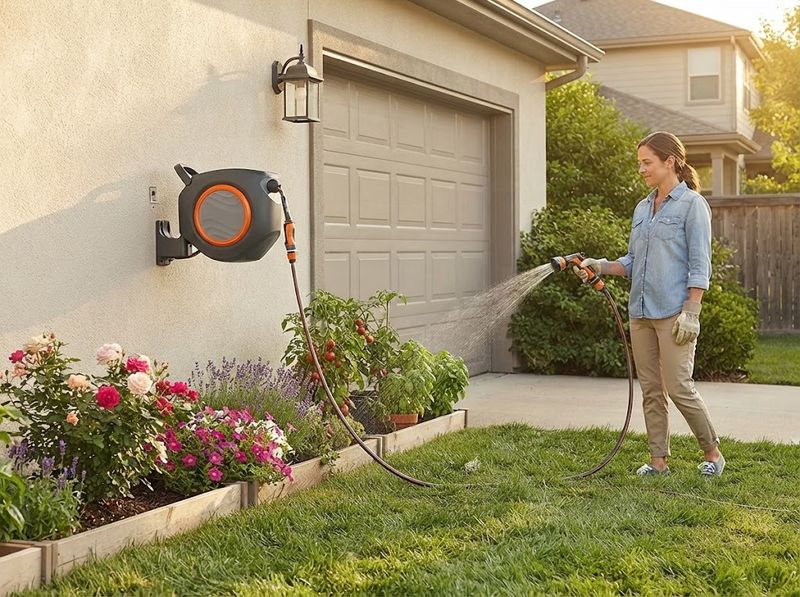
Hang the air reel from a ceiling joist in a two-bay garage and the hose drops straight to the work instead of snaking 20 ft across the floor. A 4x4 post carries the garden bracket outside when the house wall sits too far from the beds, so you drive lag screws into solid wood rather than vinyl siding. Swing the 180-degree swivel once the bracket is seated and the feed moves from the driveway to the vegetable rows without dragging the line across a lawn edge.
Owners who mounted on a post finished the same afternoon as a wall install, minus the siding holes and the stud hunt. The same Ruvup Garden Hose Reel bracket seats on studs, a floor plate, or that post, and takes about an hour either way.
Pull the hose to the flower bed, let go, and the reel takes it back without a tangle. Wall-mounted reels cover the yard and the garage: a 100 ft garden line, a 150 ft garden line, and a 75 ft air line. Each bolts to wall studs or a wooden post, and each locks at whatever length you stopped at.
Start with the number you can verify in an afternoon: 4.2 stars across 763 verified buyer reviews on a wall mounted hose reel brand you had never typed into a search box. The caveat that average hides sits in the one-star entries: a handful of owners left the 100 ft line stretched near full for two weeks and watched the recoil spring weaken. Ruvup bolts wall mounted hose reels onto siding, studs, and 4x4 yard posts, and every model it sells hangs off a bracket rather than rolls on a cart.
Hang the 100 ft garden reel by the beds, or run the 75 ft air line out to the far bay of the garage, and the 150 ft reel covers a half-acre lot in one pull. The badge stamped on the housing reads R RUVUP on some pages, which trips up buyers comparing two tabs at midnight over the same reel. The three-layer garden hose on two of the reels takes full mains pressure through a whole watering season; the third carries an air-tool hybrid line out to a compressor instead.
One buyer skipped the house wall, bolted the assembled reel to a wooden post mid-yard, and had it watering the rows the same afternoon. That post saved him drilling into vinyl siding, the one step that stops most people from mounting anything at all across three summers of good intentions. Run a thumb along the housing seam the day the crate lands; the retailer's 30-day return window covers a cracked shell, a bracket that misses your studs, or the wrong length.
Read the full brand storyMounting runs about 60 minutes with a drill, a stud finder, and the 4 expansion screws packed in the box.
Mark two studs at chest height, then hold the 34 lb housing flat against the wall.
Sink the expansion screws through the metal bracket into solid wood, not drywall alone.
Walk the hose to the far bed; the ratchet catches at whatever length you stop.
One short tug releases the catch, and the drum winds back about 10% slower than a bare spring.
Owner reports pulled from the 763 verified reviews behind the 4.2-star average, the three-star ones included.
Setup took one afternoon and the retraction is smooth. Read the instructions first: you pull the hose out, then turn the water on. Walking the full line out before going back to the spigot is the one habit you have to learn. Once you have it, the reel does the rest. It locks wherever I stop, and I have not coiled a hose by hand since April.
We ran a 1/2-inch retractable from another brand for two years, and moving up to the 5/8 bore was the upgrade I wanted. More water actually reaches the nozzle. The wider line kinks a little more easily if you yank it, but you hear the ratchet click as you walk out, and the lock holds exactly where you leave it. The retraction mechanism feels heavy duty rather than springy.
Convenience and storage are what sold me, and it retracts easily every time. My one complaint: getting the last stretch of hose out is a bit of a tug of war at the start. Probably comes with the length. Still glad I bought it, and the drum has not jammed once in three months.
It arrived fully assembled, so all I did was mount it. I used a wooden post instead of the house wall, which took about an hour with a socket wrench. The unit is not heavy for its size, and the swivel lets me water the driveway side and the vegetable rows from the same spot. The multi-pattern nozzle covers everything from a power rinse on the patio to a shower head for flowers. When winter came I lifted the reel off its bracket and stored it in the garage.
Much easier to put away than doing it by hand, and the reel looks tidy on the wall. You do lose some pressure across a run this long, which is physics rather than a defect, so plan for it if you want a hard jet at the far end. Still recommend it.
It ran flawlessly for months. Then I left the hose stretched out near full for two weeks straight to water new plantings, and the recoil spring fatigued: about ten feet would not wind back. I sent photos to the support team and they shipped a replacement free of charge, fast. Five stars for that alone. Now I let it retract between waterings and it has behaved since.
This is a serious piece of hardware. The frame is thick steel and the springs are noticeably stronger than the reel it replaced. What I did not expect: once the stopper hits the rollers you hear a clutch engage, so the coupling does not slam to a halt at the end of a pull. Mounting it high on the wall takes two people or a very confident stepladder.
Good build out of the box, but read the numbers before you order. The hose is rated 300 PSI while the reel body tops out at 150 PSI, and the manual warns against extreme temperatures. Once I regulated the compressor down it has handled garage work without a complaint.
Ruvup's reel mounts to two studs in 60 minutes, runs a full watering season, then has to survive the first hard freeze.
Mark two studs, drive the expansion screws, and hang the 34 lb housing before dinner. Inspect the shell and bracket that same evening, because the 30-day return window is your moment to catch freight damage.
Pull the line to the far bed, let go, and watch it stack flat on the drum. The ratchet holds at whatever length the beds need, so the hose stops fighting you by the third watering.
Six weeks of daily watering later, the mounting bolts have taken the pull load without loosening. Rinse mud off the line before it winds back and the drum keeps layering evenly.
After the first hard freeze, run a thumb along the housing seam for cracks. The anti-UV, anti-freeze polymer is built to take a full summer of direct sun and a winter on an unheated wall.
Ready for Day 1? Match the reel length to your longest run before you drill. Compare the garden and air reels.
A 100 ft auto-rewind reel earns its two drill holes in the yard that waters daily and the garage that runs air tools.
You have coiled the same 50 ft hose by hand every evening for three years, and it folds at the same spot every time. Pull the line to the far bed, let go, and the drum takes all of it back before you reach the spigot. Your evening coil drops out of the routine from the first watering on.
Wheel the floor jack to the far bay and break lug nuts 75 ft from a compressor that never moves off the door wall. The 75 ft hybrid line feeds through 1/4 NPT brass couplers overhead, so the hose stays off the concrete while you work under the truck.
Sink a 4x4 post between the beds when your siding is vinyl and the rows sit 40 ft from the house. Bolt the metal bracket to solid wood, and the 180-degree swivel feeds the driveway and the vegetable rows from one central point all season.
You want a printed pressure number before you spend a Saturday drilling into siding, not adjectives. Read the 348 PSI on the garden hose, the lower body limit the air reel publishes, and the 763 verified reviews behind a 4.2-star average, line by line.
Read the objections that surface before you click, including the complaint a 4.2-star average across 763 reviews quietly buries.
Cheap hoses fold at the mouth of the reel on the first sideways tug, because nothing steers them back onto the drum. Drag this line in from a 45-degree angle and the spring-loaded guide layers it flat across the drum anyway. The fold that used to show up at 30 ft stops showing up by the second week.
Owners who bought a reel from a brand with no showroom checked the reviews first, and 763 verified ones sat there across the three reels. Read the one-star entries before the five-star ones, because that is the honest half of a 4.2-star average. Twenty minutes of that reading tells you more than a decades-long brand story would.
4.2 stars across 763 verified buyer reviews
One owner left the 100 ft line out at roughly 80 ft for two weeks of twice-daily watering, and the recoil spring fatigued until about 10 ft would not wind back. Support shipped a replacement unit free of charge after a photo exchange that took two messages. Let the hose retract between waterings and the spring never sits stretched that long. Owners who wind it back nightly report the same drum tension a full season later.
At 34 lbs the housing rests on a stepladder shelf or a knee while you drive the first screw. Mark the studs with a pencil before you lift, not after the weight sits on your shoulder. The metal bracket carries the full load once two screws are seated, and the second one goes in easy.
763 verified buyer reviews across the three reels
Open the crate the day it lands and run a thumb along the housing seam and the bracket welds. Freight damage does show up in the reviews: a split shell, a hose scuffed on the underside by a rough pallet. The retailer's 30-day return window covers a damaged arrival, and the support desk has replaced units outright after a photo exchange.
Freight damage ships back inside 30 days through the retailer. Pick a length and check the specs.
The questions buyers send before they drill, answered with the published figures rather than adjectives.
A spring-loaded drum pulls the hose back into a housing on its own, so the evening coil disappears from the routine. Walk the line out to the beds, water, tug once, and let go. The hose stacks itself flat inside the case instead of lying in a loop on the lawn where a mower finds it.
Pull the hose out to the length you need and stop; the ratchet catches and holds it there. Turn the water on at the spigot after the hose is out, not before, because a pressurised line is harder to pull. When you finish, tug once to release the catch and walk the hose back as it winds.
The reel arrives assembled with the hose already wound. Inside the box you also get the metal wall bracket, a set of expansion screws, an instruction booklet, and a multi-pattern spray gun. Nothing beyond a drill, a stud finder, and a socket driver is needed to finish the mount.
The air version runs a hybrid polymer line built for compressed air rather than water, on a steel frame instead of polymer housing. It mounts to a wall, a floor, or a ceiling, where the garden reels are wall-bracket only. It also uses a 12-position ratchet rather than a stop-anywhere catch, and carries 1/4 NPT brass fittings for pneumatic tools.
Assembly is done at the factory, with the hose already wound on the drum. The only work left is fixing the bracket to a stud and hanging the unit.
The housing carries an R RUVUP badge while search boxes shorten it to Ruvup, so the same product surfaces under both spellings. Descriptions also swap between auto rewind hose reel, wall mounted hose reel, and retractable water hose. Those are naming variants for one unit, not separate versions.
The 75 ft air reel is the workshop unit: steel frame, brass fittings, and a mount rating for wall, floor, or ceiling. Garden reels are sized for domestic water pressure and outdoor watering, not shop air. For continuous commercial duty above 150 PSI at the reel body, a heavier industrial reel is the right call.
That figure describes the garden hose material, built in three abrasion-resistant layers, and it is the number quoted on the two garden reels. The air reel is where the distinction bites. Its hybrid line carries a 300 PSI material rating while the manual limits the reel body itself to 150 PSI. Size a compressor regulator to the reel-body figure, because the body and its fittings are what give way first, not the hose jacket. Publishing both numbers separately is the only way that spec means anything.
Bore size decides flow, not reach. The 5/8-inch line moves noticeably more water per minute, which matters for sprinklers, patio washdowns, and long runs where pressure drops. The narrower 1/2 bore is lighter to pull and lets a 150 ft length stay manageable on a wall bracket at 34.4 lbs.
Flow loss over distance is a function of bore and length together. A wider bore loses less pressure across the same run, so at 100 ft the 5/8-inch model keeps a stronger jet at the nozzle. The 1/2 bore trades some of that flow for lighter handling across a 150 ft run.
The garden reels weigh 34 lbs and 34.4 lbs, hose included. Mark your studs before you lift, rather than balancing 34 lbs while hunting for solid wood.
Plan for a footprint of roughly 22.2 x 10.6 x 18.69 in on the garden reels and a little under that on the air reel. Leave swing room on the mount side so the 180-degree swivel can turn without hitting a downpipe or a window frame. Chest height keeps the hose off the ground when it feeds out.
Published sources disagree with each other. One calls the same gun a nine-pattern head, another calls it ten, so treat it as a multi-pattern nozzle rather than a fixed number. In practice it covers jet, shower, mist, and cone. Any standard-thread nozzle can replace it if you prefer a metal head.
Retraction is deliberately damped: about 10% slower than a bare recoil spring would pull it. That reduction exists so the coupling does not whip back and strike the housing or a shin. Compared with hand-coiling a 100 ft line, it still returns the hose in seconds rather than minutes.
The ratchet clicks as the hose pulls out, close to a socket wrench. Rewind is a low rolling sound from the drum, and nothing runs on power.
Its hybrid line is rated from -40F to 150F, which is why it can stay bolted to an unheated garage wall through a hard freeze without stiffening into a coil. The garden reels use anti-UV, anti-freeze polymer housings, though the source data states no numeric range for them.
The air unit measures 18.1 by 9.1 by 18.1 inches on a professional-grade steel frame with brass fittings. Owners describe the frame as noticeably thicker than the light gauge used on sub-100 dollar reels, which is what lets it absorb the recoil load when a stiff hose slams home.
Connections are 1/4 NPT solid brass at both the tool end and the compressor lead, which is the default thread in most home and auto shops. A 6.5 ft lead hose links the reel to the compressor port, so no adapter hunt is needed for standard couplers.
No certified ingress rating appears in the product data. The claims are descriptive: UV resistance and freeze resistance on the polymer housings, and a stated temperature range on the air line. Treat those as manufacturer descriptions rather than a third-party test result.
The honest measure is whether the hose actually gets put away. Owners moving up from a wall hanger report the reel is the first storage they use every single time, because putting it away takes one tug instead of five minutes of coiling in the dark. Set that against a budget reel that folds its hose at the mouth in month two and has to be bought again by August. The published numbers are what separate the two: a stated pressure rating, a stated roller count, a stated housing weight.
Buyers who tried that route report hoses shorter than advertised and thinner wall material that kinks on the first sideways pull. The published numbers are the difference worth checking: a stated 348 PSI rating, a stated roller count, a stated housing weight. A product page that publishes none of those is asking you to guess.
No brand-published warranty term appears in the product data, so treat any specific duration you see quoted elsewhere as unconfirmed. The dependable protection is the retailer's standard 30-day return window. Beyond that, owners report the support desk replacing failed units free of charge after a photo exchange.
Nothing in the published product information requires registration for basic coverage, and no registration-gated term is confirmed by the brand. If a card in your box asks for it, registering costs nothing. Do not count on an extended period that is not stated in writing on the product page you bought from.
Cracked shells and hose scuffed along the underside do appear in the review history, and they read as freight handling rather than manufacturing defects. Open the crate the day it lands. Run a thumb along the housing seam, check the metal bracket for bends, and pull a few feet of hose out to confirm the drum turns freely. Damage caught inside the retailer's 30-day return window goes straight back, and the support desk has separately replaced units outright after owners sent photographs of the fault.
The documented pattern is photo-based. One owner whose recoil spring fatigued after two weeks at near-full extension sent images to the support team and received a replacement unit at no charge, and rated the response speed five stars in the same review. That is one case, not a service-level guarantee.
Every product here sells online through its own retail product page rather than a standalone brand store. Pricing moves, so check the current price on the product page instead of trusting a figure quoted in an article. Stock status shows on the same page.
The 4.2-star average is computed from 763 verified buyer reviews across the three reels: 352 on the 100 ft garden model, 353 on the 150 ft garden model, and 58 on the air reel. The mower and nozzle carry no reviews at all, so no rating claim is made for them.
Post mounting is common and often better. A 4x4 post sunk mid-yard puts the reel closer to the beds, and the 180-degree swivel then feeds both directions from one point. One owner chose a post specifically to avoid drilling siding and had it watering the same afternoon.
Siding alone carries nothing. Fasteners must pass through the vinyl and into a stud or solid sheathing behind it, and you may need to open the bracket holes slightly to clear a vinyl post sleeve. Where no stud sits in the right place, a post mount avoids the problem entirely.
Chest height works for most installs, roughly 4 to 5 ft off the ground. That keeps the hose off the soil as it feeds out, puts the release tug at a natural arm position, and leaves the housing above mower and trimmer height.
Standard garden hose thread is the assumption on the lead connection, and buyers report normal spigot fits. Product data does not spell out the thread standard explicitly, so confirm on your own tap before ordering if you have an unusual outdoor fitting. A brass adapter from any hardware store bridges the gap if needed.
Running a secondary line from the spigot to a post-mounted reel is a standard workaround for beds far from the building. Bury or clip the leader along a fence line so the mower misses it. The reel then serves the far side of the yard without a permanent plumbing run.
A battery or wifi timer installs at the spigot, upstream of the lead hose, and the reel behaves normally downstream. Leave the hose extended to the sprinkler position and locked, so the timer waters and nobody has to pull the line.
Shutting the tap between sessions is the safer habit regardless of the hose rating. A line left under mains pressure for days stresses every washer and coupling in the run, and a failure while the house is empty floods unattended. Pressure rating protects against bursting, not against a slow weep at a fitting.
A 100 ft run typically covers a small orchard or a large garden if the reel sits centrally rather than at one corner. Mount the bracket between the water source and the trees to halve the effective distance. Where the plot is longer than wide, the 150 ft model removes the guesswork.
A cart wheels between a front and back spigot and needs no drilling, which suits renters. A wall or post mount trades that mobility for a fixed, spring-loaded rewind that puts the hose away in one motion. Retractable reels need the mount to give the spring something to pull against, so mobility and auto-rewind rarely coexist.
A ground or post mount usually wins on long runs because you can place the reel centrally instead of at the building line, which shortens every trip. Wall mounts win on rigidity and keep the housing off wet soil. Both use the same metal bracket here.
Buyers cross-shopping these brands weigh three things: how smoothly the hose winds back, how solid the mounting bracket is, and whether the connectors are proprietary. That last one matters more than it looks. Proprietary fittings lock every future nozzle, sprinkler, and replacement lead into one brand's parts shelf. These reels use standard garden hose thread on the water outlet and 1/4 NPT on the air unit, so a hardware-store nozzle or coupler fits without an adapter. On published specs, the pressure and temperature figures here are stated rather than implied.
Two-wheel carts pivot easily and load into a truck bed without a ramp. Four-wheel carts sit more stable on a slope and take a heavier hose without tipping when you pull. Neither offers spring rewind, which is the whole point of a retractable reel.
Stainless braided hose is close to kink-proof and light, but it will not wind onto a retractable drum properly and can be hard to seal at the fittings. Heavy rubber survives sun better than vinyl and layers well on a reel, which is why retractable reels ship with a layered polymer or rubber line rather than steel.
Drain the line before the first hard freeze: shut the spigot, disconnect the lead hose, pull the hose out and let it empty downhill, then let it retract dry. Water left standing inside is what splits a hose wall when it freezes. The housing itself can stay on the wall through the season.
Mud and grit on the hose jacket are the usual cause, because dirt binds the line against the guide. Pull the hose fully out, wipe it down with a cloth along its length, and let it wind back clean. If it still catches at one point, check the drum for a wrap that has crossed over itself.
Spring fatigue is the failure mode owners report, and it follows the same pattern: the hose left extended near full length for days or weeks. One owner lost about 10 ft of retraction after two weeks at roughly 80 ft, and support replaced the unit free after photos. Letting the hose retract between waterings is the practical prevention.
Retractable reels are built around the specific hose they ship with, matched to drum diameter and spring tension. Swapping in a thicker or stiffer hose usually jams the guide or overwhelms the recoil. Where the hose fails rather than the mechanism, ask support about a replacement unit; that is the documented route.
Washers fail before brass does. Rubber flattens with heat cycles and hard water scales the threads. Replace washers each spring and wipe the threads before reconnecting.
Three habits cover it. Keep the hose free of caked mud so the guide tracks cleanly, let the line retract fully between sessions so the spring never sits stretched, and drain the hose before winter. Check the two mounting screws once a season, because repeated pulls slowly work fasteners loose in wood.
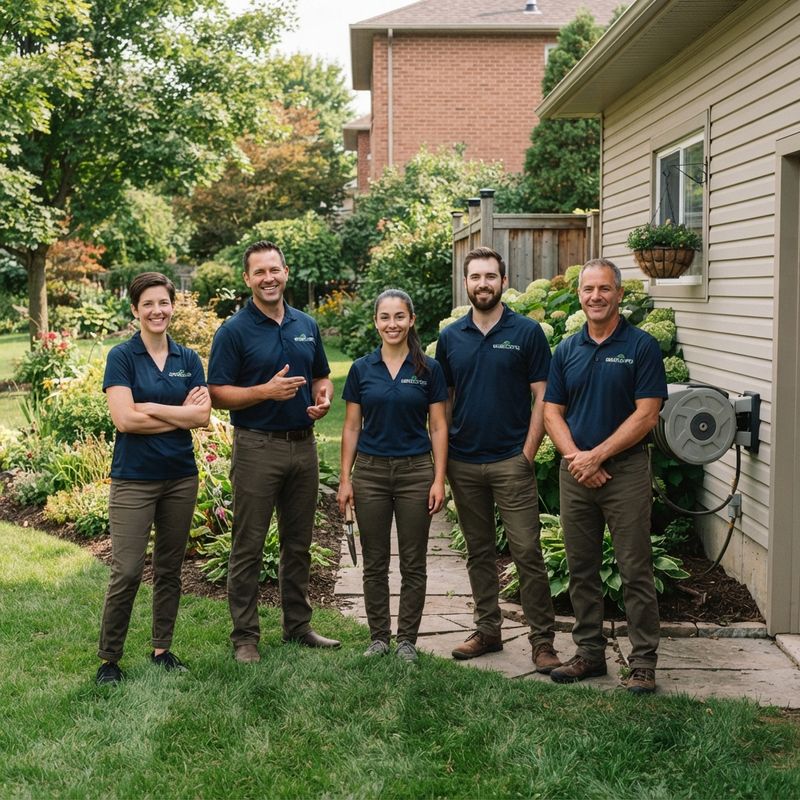
Mounted on a house wall, a mid-yard post, and a two-bay garage wall, with the nozzle and mower that share the same yard.
Amazon pricing updates daily — check today's price
See the reels